Restoring the Sacred

Friday, February 7, 2014

Words of Relevance: Plato on Civilizational Decay


Plato, in his Socratic dialogue and best known work, The Republic, written in 380 B.C., warned us of possible pitfalls that could lead a society toward civilizational decay.

Here's the quote:
“A society in which there is a multiplicity of doctors and lawyers is already a sick society,...constant litigation and consultation are signs of civilizational decay.  Complete absorption in the pursuit of justice and health somehow ends up with neither.”


Thursday, February 6, 2014

Words of Relevance: Flannery O'Connor: Tenderness & Terror


Flannery O'Connor (March 25, 1925 – August 3, 1964), has been described by Fr. Damien Ference on the Word on Fire Blog as:
One of the greatest disciples of the twentieth century was neither a priest, nor a religious, nor a married person. She was a celibate, single woman who spent the last 13 years of her life battling lupus while writing some of the best fiction the world has ever known—all while living on a 544-acre dairy farm in Milledgeville, Ga. with her mother, her books, and forty-four peacocks. Her name was Flannery O’Connor.
Today's quote manifests her concern over attempts by the secular world to discredit faith in the goodness of God, and replace it with a misunderstanding of the origin of tenderness.

Here's the quote:
One of the tendernesses of our age is to use the suffering of children to discredit the goodness of God, and once you have discredited his goodness, you are done with him... In this popular piety, we mark our gain in sensibility and our loss in vision.  If other ages felt less, they saw more, even though they saw with...faith.  In the absence of this faith now, we are governed by tenderness.  It is a tenderness which, long since cut off from the person of Christ, is wrapped in theory.  When tenderness is detached from the source of tenderness, its logical outcome is terror. 

Mary Beth Bonacci, expounded on the relevant words of O'Connor in a piece she wrote at IgnatiusInsight.com, entitled:   Compassion Leads to the Gas Chamber?


Wednesday, February 5, 2014

Words of Relevance: The Seahawks and Jesus


The 2014 Super Bowl was, for all Peyton Manning fans, a  great disappointment, but the below linked video has erased any feeling of disappointment for at least one such fan.  The comments made by members of the newly crowned champions are certainly words of relevance - especially to our youth, who might be totally consumed with the pursuit of  worldly accomplishments, perhaps forgetting their place in the total scheme of things.

Here's the video:

http://www.youtube.com/watch?v=s8U_ewtHZdw


H/T: rkwlsn

Tuesday, February 4, 2014

Words of Relevance: G. K. Chesterton: The Value of Purity


Dale Ahlquist, the president and co-founder of the American Chesterton Society, is the creator and host of the Eternal Word Television Network series, "G.K. Chesterton: The Apostle of Common Sense."  He wrote an essay today on the Blog of Crisis Magazine, entitled: Sin and Purity.

Drawing on Chesterton in his essay, Ahlquist tells us: It should not be that difficult to understand what purity is, and that when we talk about purity, we mean something that has not been befouled by something that befouls, namely sin. There is something all-or-nothing about purity. Purity needs to be completely pure to get itself so called. A little purity does not go very far. A teaspoon of clean water does not purify a tall glass of sewage, but a teaspoon of sewage utterly ruins a glass of clean water. But physical cleanliness should not be confused with moral purity. As Chesterton says, “Saints can afford to be dirty, but seducers have to be clean.”… Though the modern world seems utterly mystified by the ideal (purity), Chesterton points out that there is an unconscious acknowledgement of it in the modern worship of children, and,

Here's the quote:
Why else would anyone “worship a thing merely because it is small and immature?”
It is because we value purity.


Wednesday, January 29, 2014

Words of Relevance: Alexis de Tocqueville & Income Inequality


Alexis de Tocqueville's main piece of writing, Democracy in America,
was published in 1835.  It tells of what he found during his travels through the New World "from the perspective of a detached social scientist."  His observations on the American view of equality (which hasn't changed in almost 200 years) might come as a surprise to Barack Obama, and his acolytes, who prefer to engage in class warfare because it aids their political agenda.

Here's the quote:
Americans are so enamored of equality, they would rather be equal in slavery than unequal in freedom.  

(Don't miss the quote on the above photo)
   

Tuesday, January 21, 2014

Words of Relevance: Fr. Schall: Redistribution & Production


We could quote Fr. Schall every day (we did in our last post) because he is one of the most prolific, and relevant, of Catholic writers.

Today while reading one of his latest books: Another Sort of Learning,
today's quote was found in Chapter 14: "The Recovery of Permanent Things." 

In discussing the often ignored relationship between production and redistribution, Fr. Schall provides extremely relevant information to those consumed by the concept of social justice without realizing how unjust their social justice can be.

Here's the quote:
We go toward redistribution as if the problems of production and their relations to justice and benevolence have somehow disappeared.  Paul's (St.Paul) "If a man will not work, neither let him eat" has been replaced by a sort of secular version of the old Communion Antiphon, "Take and receive."…Clearly we do not understand, as P.T. Bauer has remarked, that "profit" is earned.  Distribution follows production and does not exist outside of it.
 

Wednesday, January 15, 2014

Words of Relevance: Fr. James Schall: Do What You are Doing


James Vincent Schall, S.J. (born January 20, 1928), writing today on the Blog of The Catholic World Report, tells of being teased by a fellow priest in the rectory on January 12th, the day of the announcement of additions to the Cardinalate by Pope Francis: “Well, Schall, I see you didn’t make it again.”

Of course Fr. Schall, who never misses an opportunity to teach, replied with our quote of the day.

Here's the quote:
We cannot go through life “missing” the things we were never cut out for in the first place. St. Ignatius, I believe, has a phrase that advises us to “agree quod agis—do what you are doing.” It has the implication that we are to try to do it well, even if we are not cardinals. 

Tuesday, January 14, 2014

Words of Relevance: Michael Joyce: Change the Church?


Michael Joyce (full disclosure: we're related), the speaker on the below linked video, was concerned about the lack of Catechesis in the Church, and decided to do something about it.  He created his own website, which he called Christian Church Logic.  He has now completed his third video presentation which will be posted below.  It's a short video, but is filled with many words of relevance.  Of course we've chosen a favorite (or three).

Here's the quote:
As a truth, marriage can only be between a man and a woman: truth can't change; truth is eternal.  Gay marriage was either always possible and always will be possible, or it was never possible and never will be possible.
The Catholic Church's Sacrament of Matrimony is a covenant uniquely expressing what it means to be a man and a woman: equal, different, complementary.
The Catholic Church's teachings on sex and marriage are beautiful, deep, rich, and life changing.
Here's a link to the new the video:

http://www.youtube.com/watch?v=_rjGSTF149A

Please visit the website (linked above) and watch (and share) the first two videos when you have time.

Saturday, January 11, 2014

Words of Relevance: Churchill on Architecture


Colette Arredondo, a graduate of the University of Notre Dame's School of Architecture, wrote an interesting piece at City Journal yesterday entitled: Sacred Revival.

Her essay is actually a review of a recent book by Duncan Stroik, a professor of classical architecture at the University of Notre Dame, entitled: The Church Building as a Sacred Place: Beauty, Transcendence, and the Eternal.

Early in her essay, she provides us with the quote of the day from Sir Winston Churchill, but she goes on to list examples in Stroik's book lamenting the loss of the sacred, most especially in the architecture of Catholic churches.  Some examples:
Stroik seeks an architecture that is inherently Catholic. For him, the “form follows function” concept is at odds with the purpose of a church building, which needs to do more than just serve the programmatic function of the liturgy. Catholicism is a religion of the senses, he explains. The architecture of its buildings should contribute to an atmosphere of transcendence.
In Catholic architecture today, fan-shaped and semicircular churches, with sloped seating for sightlines, are all-too-common. High altars have been replaced with priest’s chairs. The tabernacle has been displaced from the central axis of the church and moved to a distinguished but separate location... “the greatest loss of the sense of the sacred in our churches in recent decades is the disregard or demotion of the sanctuary within the house of God.”
Stroik clearly favors the traditional basilica and cruciform churches, in part because they are instantly identifiable as churches, which many modernist church buildings are not.  
Arredondo, as stated, opened her essay with the quote of the day by Churchill, who, in May 1941, after German bombing had destroyed the Commons Chamber of the U.K. House of Commons, and when discussions were underway as to how to rebuild "in a way that preserved the 'form, convenience, and dignity' of the destroyed chamber, which dated to 1852," said the following in a speech before the Commons:

Here's the quote:
 “We shape our buildings, and afterwards our buildings shape us.” 


Thursday, January 9, 2014

Words of Relevance: W. F. Buckley: STOP!


William Frank Buckley, Jr. (November 24, 1925 – February 27, 2008), was, for his entire adult life, the de facto leader of the American Conservative movement.  He wrote more than 50 books on various topics, and even found time to write a series of novels featuring a mythical CIA agent, Blackford Oakes.

In 1955, he founded the Conservative journal, National Review, and remained its editor-in-chief until 1990.  The magazine became, and has remained, the standard-bearer of American Conservatism.

In 1965, he ran for Mayor of New York, and when asked what he would do should he win, replied: "I would demand a recount."  His most famous quote, though, was coined at the introduction of his beloved National Review, by way of its mission statement, issued on November 19, 1955.

Here's the quote:
It stands athwart history, yelling Stop, at a time when no one is inclined to do so, or to have much patience with those who so urge it.
Why are Buckley's words so relevant today?  Fifty-eight years later, the voters of New York City elected a man, who by all appearances is the most Left-wing radical politician (and that is by far the kindest appellation that could be used in describing him) that could be found in the city, to serve as their mayor.  God help them.

Wednesday, January 8, 2014

Words of Relevance: W. B. Yeats "The Second Coming"


William Butler Yeats,  probably the most renown of Irish poets (he even served two terms as an Irish Senator), is remembered for many of his writings other than the one deemed, at least in this corner, his most prescient.  Written in 1919, The Second Coming
presages our current state of affairs with elected officials.  Surely his two terms in political office had some influence on his writing.  Here's the first stanza of the poem without the last couplet, which will be the quote of the day:
    "Turning and turning in the widening gyre
    The falcon cannot hear the falconer;
    Things fall apart; the centre cannot hold;
    Mere anarchy is loosed upon the world,
    The blood-dimmed tide is loosed, and everywhere
    The ceremony of innocence is drowned;
Here's the last two lines, and today's quote:
    "The best lack all conviction, while the worst 
            Are full of passionate intensity."
     

Thursday, January 2, 2014

Words of Relevance: Chesterton: What's wrong with the world?


G. K. Chesterton (29 May 1874 – 14 June 1936) was once asked by a London newspaper to join with other recognized authors and erudite thinkers of the time to comment on the perennial question: "what's wrong with the world."  His answer was sent to the newspaper by letter, which is today's quote:

Dear Sirs,
I am.
Sincerely yours,
G.K. Chesterton 

Wednesday, January 1, 2014

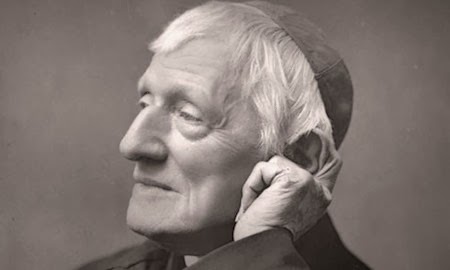
Words of Relevance: John Henry Newman: Evil and the World


The Catholic Thing Blog today posted one of the always extraordinary sermons of John Henry Cardinal Newman.  Their post is "Adapted from No. 7 of Sermons on Subjects of the Day."

Newman, writing almost two centuries ago, clearly points out a problem that, if anything, has been exacerbated by our culture today.

Here's the quote:
"The one peculiar and characteristic sin of the world is this, that whereas God would have us live for the life to come, the world would make us live for this life. . . .not for the next. It takes, as the main scope of human exertion, an end which God forbids; and consequently all that it does becomes evil, because directed to a wrong end. . . 
"The world has many sins, but its peculiar offence is that of daring to reason contrary to God’s Word and will. It puts wrong aims before itself, and acts towards them. It goes wrong as if on principle, and prefers its own way of viewing things to God’s way…"


Wednesday, December 25, 2013

Words of Relevance: Isaiah on The Coming of Christ (mas)


The birth of Jesus, which we celebrate today, was prophesied centuries before the event, most notably by the prophet Isaiah.  According to Wikipedia: :The oldest surviving manuscripts of Isaiah are two scrolls found among the Dead Sea Scrolls; dating from about a century before the time of Jesus, but those manuscripts have been dated to as far back as 408 B.C.  There are two well known and relevant quotes from Isaiah about today.

Here's the first:
Therefore the Lord himself will give you a sign. Behold, the virgin shall conceive and bear a son, and shall call his name Emmanuel.  
The second will be recognized from George Frideric Handel's Magnus opus, Messiah.
Here's the quote:
For unto us a Child is born,
 Unto us a Son is given;
 And the government will be upon His shoulder.
 And His name will be called 
Wonderful, Counselor, Mighty God,
 Everlasting Father, Prince of Peace.

MERRY CHRISTMAS! 

Thursday, December 12, 2013

Words of Relevance: Pope Paul VI: the Great Prognosticator


Pope Paul VI, wrote a landmark encyclical, which was promulgated on July 25,1968.  It was entitled: Humanae Vitae.  It was perhaps the greatest, and clearest (not to mention timely) encyclical written in my lifetime.  Unfortunately, it went mostly unread, and almost totally unheeded, thanks in large part to a failure on the part of clerics to fully support it.  There was a joke making the rounds at the time about an old Italian woman listening as the Pope discussed his encyclical from his balcony at the Vatican.  The woman supposedly spoke rather loudly: "He no playa da game; he no maka da rules."  She never obviously considered that the rules were not coming from him, and neither, apparently, did any of the clerics who disagreed with him.

Breaking from the usual format of providing one or two relevant quotes, herewith is a short summary of the Prophecies of Humanae Vitae, originally published by Fr. Paul Marx, OSB, on the Blog of The Population Research Institute. 


"On July 25, 1968, Pope Paul VI’s Humanae Vitae re-affirmed the Catholic teaching on life, love and human sexuality.  In that document, he listed the consequences of life lived outside Catholic teaching.  
"He predicted that:
1. Contraception would lead to conjugal infidelity.
2. Contraceptive practice would lead to a “general lowering of morality.”
3. Contraception would lead men to cease respecting woman in their totality and would cause them to treat women as “mere instruments of selfish enjoyment” rather than as cherished partners.
4. And finally, widespread acceptance of contraception by couples would lead to a massive imposition of contraception by unscrupulous governments.  
"In other words, Pope Paul VI predicted that contraception would evolve from “a lifestyle choice” into a weapon of mass destruction.  How dreadfully his prophecy has been vindicated by population control and coercive sterilization programs, fertility reduction quotas and the promotion of abortion literally everywhere in the world.
"Contraception’s destruction of the integrity of the marital act—as unitive and procreative—has dire consequences for society and for our souls.  Contraception, in other words, is a rejection of God’s view of reality.  It is a wedge driven into the most intimate sphere of communion known to man outside of the Holy Sacrament of the Mass.  It is a degrading poison that withers life and love both in marriage and in society.
"By breaking the natural and divinely ordained connection between sex and procreation, women and men—but especially men—would focus on the hedonistic possibilities of sex.  People would cease seeing sex as something that was intrinsically linked to new life and to the sacrament of marriage.
"Does anyone doubt that this is where we find ourselves today?"
I read recently (wish I could remember where) that we have entered an age of hedonistic narcissism.  Can't argue with that.

The Bellarmine Forum is running a Campaign for Humanae Vitae on their Blog site, and you can sign the petition on the website.  

You can also listen to a Podcast by Dr. Christopher Manion of the Bellarmine Forum discussing the failure on the part of many clerics (including Cardinal Timothy Dolan) to address Humanae Vitae since its promulgation, by clicking Here.


Wednesday, December 11, 2013

Words of Relevance: Allan Bloom and Political Men


Allan David Bloom (September 14, 1930 – October 7, 1992), one of our great professors, philosophers, and classicists, is most famous for his magnus opus: The Closing of the American Mind.  His first book was a collection of three essays on Shakespeare's plays, entitled: Shakespeare's Politics (1964), and today's relevant quote is taken from that work.  Bloom is countering the idea that the family is not the most important aspect of politics (an idea espoused by Plato and others, who believed more in the "just city").  The quote is in his essay on "Richard II":

Here's the quote:

"…the exquisitely refined souls do not belong in the best political men."

Monday, November 25, 2013

Words of Relevance: H.L. Mencken: Democracy and the Narcissistic Moron


H.L. Mencken (1880 - 1956), the "Sage of Baltimore," was a journalist, satirist, critic, and Democrat. He wrote many editorials while working for the Baltimore Evening Sun, nearly every one of which is a classic.

Today's quote is from the July 26, 1920 edition of the Baltimore Evening Sun and, although written and published 93 years ago, it could not be more relevant to our present time (and administration).

Here's the quote:
"As democracy is perfected, the office of the President represents, more and more closely, the inner soul of the people. On some great and glorious day, the plain folks of the land will reach their heart's desire at last and the White House will be occupied by a downright fool and complete narcissistic moron."


H/T: datansey00

Sunday, November 24, 2013

Words of Relevance: Gerhart Niemeyer on "Hope"


Gerhart Niemeyer (with his friend William F. Buckley, Jr.), was one of the greatest minds of our time, as attested by some of the other great minds of our time.  Dr. Christopher Manion mentioned him today in a post at The Bellarmine Forum, entitled: "Hope in the Rearview Mirror."

One of those other great minds of our time, Angelo Codevilla, wrote a tribute to his former teacher on The University Bookman after Niemeyer died, in which he said the following: "Niemeyer’s life embodied the Platonic lesson he passed on to us—that to grow in understanding is to grow closer to God."  

There are too many relevant quotes of Niemeyer provided by Dr. Manion in his referenced post to choose just one, so herewith more than one:
"...not only Communists but all other varieties of progressive have raised hope as the flag around which their supporters rally.”
“Christian hope is for things imperishable, not confined to this world – things promised by God and secured by Jesus Christ. With a view to this imperishable glory, the entire Christian life is illumined and transfigured by hope. Hope thus is an enduring quality of a Christian life, together with faith and charity.”  

But the true believers on the Left:
"have drawn their secular hopes not from Christian sources but from futuristic ideologies."


Tuesday, November 19, 2013

Words of Relevance: President Lincoln on The Virtue of Silence


On this the 150th anniversary of President Lincoln's Gettysburg Address, it's fitting to remember that the main speaker at Gettysburg that day was former secretary of state Edward Everett, who spoke for two hours on the events of the day.  Lincoln was asked only to say a few words to close the program.  He did that and much more.  His closing remarks: two hundred and seventy-two words, delivered in a littler more than two minutes, have gone down in history as one of the greatest political speeches ever delivered.  Members of our current administration, who did not pick up on the clear lesson imparted by President Lincoln that day, should pay heed to something else he said that is extremely relevant today.

Here's the quote:
"Better to remain silent and be thought a fool, than to speak and to remove all doubt."


Monday, November 18, 2013

Words of Relevance: Two Popes and Relativism


Pope Emeritus Benedict XVI began speaking out against what he called "The Dictatorship of Relativism" even before he was elected Pope on April 19, 2005.   He spoke of it often, and even Progressive Catholics understood what he meant even if they  did not agree with him on the severity of the problem.  During his papacy, he related how relativism tended toward political correctness and thereafter to intolerance.
Here's the quote:
“In recent years I find myself noting,” how the more relativism becomes the generally accepted way of thinking, the more it tends toward intolerance. Political correctness … seeks to establish the domain of a single way of thinking and speaking. Its relativism creates the illusion that it has reached greater heights than the loftiest philosophical achievements of the past. It presents itself as the only way to think and speak — if, that is, one wishes to stay in fashion. … I think it is vital that we oppose this imposition of a new pseudo-enlightenment, which threatens freedom of thought as well as freedom of religion.”
Pope Francis, on the other hand, has given unscripted interviews recently that have some members of the Church scratching their heads and wondering how the current pontiff feels about relativism.  There have been a number of interpretations rendered by various Catholic pundits on what the Pope actually meant when he said certain things, but what he actually said seems to indicate that he feels less inclined than his predecessor to encourage the faithful to guard against the cult of relativism so pervasive in our culture.  Those hoping for an acceptance by the Church of fundamental changes in Catholic doctrine, however, have been disappointed at every turn (so far) when Pope Francis confirms that doctrine at every opportunity.  They still, though, cling to certain utterances that give them hope.  Here's the quote:
"When I meet a gay person, I have to distinguish between their being gay and being part of a lobby. If they accept the Lord and have goodwill, who am I to judge them? They shouldn't be marginalized. The tendency (to homosexuality) is not the problem ... they're our brothers."
Apparently some of our brothers take the absence of the word "repentance," and the failure to mention what we've always been taught: "Love the sinner; hate the sin," as an encouraging sign that Pope Francis is dismissing any such admonishments.  They shouldn't do that.